



Consumer Report 2025 - GenAI, Social Commerce and Communities: What Consumers Truly Think
Download Index
Index
Afficher plus
Afficher moins

Top 10 Product Review Websites to Build Customer Trust in 2026
 14
mn
14
mn
par
Asmita


In a crowded retail market, consumer purchase decisions are shaped long before anyone reaches checkout. Shoppers read online reviews, compare ratings, and form opinions about a brand before adding a single item to their cart. For those in retail and brand-led industries, online reputation is an active driver of visibility, customer trust, and conversion rate.
But the industry has a growing problem of fake reviews flooding open platforms, and any anonymous account can submit feedback regardless of purchase history. This erodes consumer confidence and makes review authenticity the defining factor for brands serious about protecting their market position.
This article ranks and analyzes the top 10 product review websites marketing and SEO teams should consider for 2026, with a clear focus on verification standards, SEO impact, and what each platform delivers for retail, consumer-facing brands. Whether you manage an online store, a multi-location retailer, or a global consumer brand, this comparative guide will help you make the right choice.
Why Product Review Websites Matter More Than Ever
The influence of online reviews on consumer purchasing behavior has never been stronger. Customer reviews now shape brand visibility, purchase intent, and conversion rate at every stage of the shopping journey. A consumer who discovers your brand alongside hundreds of verified, recent reviews is far more likely to buy and return, than one who finds a sparse or unverifiable profile.
The core challenge is credibility. The proliferation of review fraud across open platforms has created a widespread crisis of consumer confidence. Research consistently shows that shoppers are becoming increasingly discerning and they look for signals that reviews are genuine before acting on them. A brand backed by authentic reviews from verified buyers carries far more weight than one with inflated ratings and unverifiable feedback.
Platforms that verify customer reviews against confirmed transaction data give every potential shopper a genuine reason to extend customer trust before ever clicking ‘Buy.’
What to Look for in a Product Review Website: A Quick Evaluation Framework
Before committing to any platform, you need a clear evaluation framework. Not all platforms are built the same, and the wrong choice can leave your brand’s ratings exposed to manipulation, limit search visibility, or create unnecessary management overhead. Two dimensions deserve the closest scrutiny.
Verification & Anti-Fake Review Mechanisms
The most critical question to ask of any platform is: How do you prevent fake reviews? Open platforms that allow anyone to submit feedback regardless of purchase history are structurally vulnerable to manipulation by competitors, bots, and disgruntled non-customers.
The gold standard in 2026 is a closed, verification-first review platform that only accepts submissions from confirmed purchasers. Before any review is published, the system should cross-reference transaction records to confirm the reviewer is a genuine buyer. Look for transparent anti-fraud policies, automated detection systems, and a clear dispute resolution process. A platform that cannot explain its verification methodology is not one you should trust with your brand’s online reputation.
Impact on SEO and Online Visibility
Customer reviews are a powerful SEO asset that retail brands consistently underutilize. Review content generates fresh, keyword-rich, user-generated text that search engines actively reward. Platforms that export structured data through schema markup can display your star ratings directly in Google Search results a visual signal that significantly improves click-through rates and conversion rate.
Before selecting a review platform, ask these questions: Does it support Google Seller Ratings? Does it offer review syndication to third-party retail and marketplace partners? Does it integrate rich snippets in organic search results? These capabilities determine whether your investment in collecting online reviews translates into measurable traffic growth or simply adds a rating badge that shoppers overlook.
The Top 10 Product Review Websites for Businesses in 2025
1. Verified Reviews — Best for Guaranteed Review Authenticity and End-to-End Management
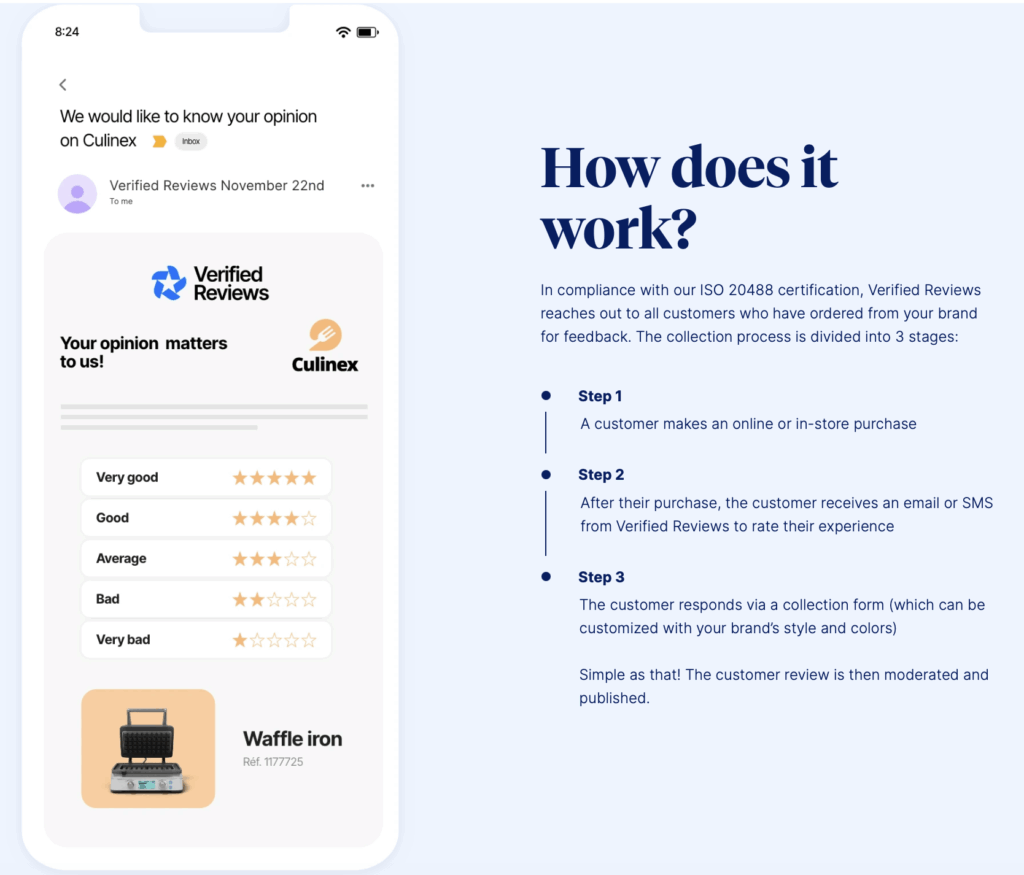
Verified Reviews is the benchmark for brands that refuse to compromise on review authenticity. Unlike open platforms, the solution collects customer reviews exclusively from confirmed purchasersevery submission is cross-referenced against verified transaction data before publication. This closed-loop approach eliminates the risk of competitor interference, bot submissions, and non-buyer feedback that would otherwise distort your brand’s public ratings.
The platform’s review management capabilities extend well beyond simple review collection. It automates post-purchase outreach, supports multi-channel publishing, and delivers analytics dashboards that connect review performance directly to sales outcomes. For those working across complex, multi-channel brands, this end-to-end infrastructure makes Verified Reviews the most complete solution for converting customer trust into compounding, measurable growth.
Best for: E-commerce brands, retailers, and consumer-facing businesses where review authenticity is non-negotiable.
2. Trustpilot — Best for Brand Visibility Among Mass Consumers
Trustpilot is one of the most recognized platforms globally for consumer brand reviews. Its strong consumer-facing presence drives significant organic search traffic, and shoppers researching a brand will frequently encounter its Trustpilot profile in search results. The tradeoff is openness: anyone can submit a review regardless of purchase history. For retail brands, maintaining accuracy requires active review management, consistent responses, ongoing monitoring, and a clear escalation process for disputed reviews.
Best for: Consumer-facing brands focused on broad search visibility and international audience reach.
3. Trusted Shops — Best for E-Commerce Trust Certification in Europe
Trusted Shops is the dominant platform in key European retail markets, particularly Germany, France, and Spain. Its Trustmark certification functions as a widely recognized quality seal that communicates buyer protection to online shoppers. The platform collects online reviews post-purchase and integrates directly with major retail platforms, making it the natural choice for European retailers seeking to establish credibility in competitive consumer categories.
Best for: European online retailers building trust credentials in regulated markets.
4. Google Reviews — Best for Local SEO and Search Visibility
Google Reviews remains the most impactful platform for brands with a local or physical presence. Star ratings displayed in Google Search and Maps directly influence click-through rates and purchase decisions making Google Review optimization one of the highest-ROI activities for any retail SEO professional. The limitation is full openness: any Google account holder can submit a reviewregardless of purchase history, making fake reviews and spam a constant reputation management challenge.
Best for: Local retailers, service businesses, and brands prioritizing local SEO and search visibility.
5. G2 — Best for SaaS and B2B Software Reviews
G2 is the leading review platform for software and SaaS products. While it sits outside the direct scope of retail and consumer brand strategy, marketing teams at software-enabled businesses may find it relevant when managing technology vendor relationships. G2 verifies reviewers through LinkedIn profiles and purchase confirmation, providing a meaningful degree of review authenticity. For most retail marketing teams, G2 serves a supplementary rather than primary role in their broader customer reviews strategy.
Best for: SaaS vendors and software companies; limited direct relevance for pure-play retail or consumer brands.
6. Capterra — Best for Business Software Comparisons
Capterra, part of the Gartner Digital Markets network, specializes in business software comparisons. Its primary audience is software buyers rather than consumer shoppers, which limits its direct relevance for most retail brand teams. However, for brands that also sell software tools or evaluate technology vendors, maintaining an active Capterra profile with current customer reviews remains a standard requirement for category visibility in the software market.
Best for: Software vendors and technology providers; less applicable for retail-first or consumer brand strategies.
7. Yotpo — Best for E-Commerce Brands Combining Reviews and Loyalty
Yotpo is a full-stack engagement platform built specifically for online retail brands. Beyond review collection, it combines star ratings, Q&A, loyalty programs, and post-purchase SMS into a single unified system, making it compelling for Shopify and Magento merchants. Yotpo’s review syndication capabilities extend the reach of each customer review to Google Shopping and major retail partners, ensuring consistent social proof across every sales channel.
Best for: Online retail brands seeking an all-in-one engagement and loyalty platform with multi-channel distribution.
8. Bazaarvoice (Influenster) — Best for Consumer Product Sampling and UGC
Bazaarvoice powers review programs for some of the world’s largest consumer goods brands. Its review syndication network distributes customer reviews across thousands of retail partner websites from Walmart.com to Best Buy, giving each review unmatched scale and reach across the shopper journey. Influenster, its community-powered sampling arm, enables brands to actively collect reviewsfrom targeted consumer communities, making it highly effective for new product launches.
Best for: Large consumer goods brands with extensive omnichannel retail distribution.
9. Amazon Reviews — Best for Direct-to-Consumer Product Discovery
For brands selling on Amazon, online reviews are foundational to product discoverability. Review scores and volume are primary ranking signals in Amazon’s own search algorithm products with strong, authentic ratings consistently outperform lower-rated alternatives for the same search terms. Brands must build review volume organically through exceptional customer experience and Amazon’s approved post-purchase follow-up programs.
Best for: Consumer brands selling on Amazon, where review volume directly drives search placement and purchase conversion.
10. Facebook Reviews — Best for Community-Driven Brand Reputation
Facebook Recommendations remain relevant for community-based businesses, local retailers, and service brands. The social sharing dimension gives positive recommendations an organic amplification effect that static review sites cannot replicate, a well-timed recommendation can extend the reach of a single online review far beyond the original reviewer’s network. As an open platform, managing your online reputation on Facebook requires consistent monitoring and active moderation to flag inauthentic or misleading submissions.
Best for: Community-driven, local, and service-based businesses with engaged social audiences.
Product Review Websites Compared
The table below compares all ten platforms across five dimensions most relevant to retail and consumer brand strategies: verification standards, primary use case, SEO impact, and retail or brand fit.Use it to identify which platforms align with your industry and review management objectives.
| Platform | Verified Only? | Best For | SEO Impact | Retail / Brand Fit |
| Verified Reviews | ✅ Yes (100%) | All industries | High | ✅Strong |
| Trustpilot | ❌ Open | Consumer brands | High | ✅Strong |
| Trusted Shops | ✅ Post-purchase | E-commerce (EU) | Medium | ✅ EU Markets |
| Google Reviews | ❌ Open | Local SEO | Very High | ✅Strong |
| G2 | ✅ Verified | SaaS / Software | Medium | ⚠️Software only |
| Capterra | ✅ Moderated | Business software | Medium | ⚠️Software only |
| Yotpo | ✅ Post-purchase | Online retail | High | ✅Strong |
| Bazaarvoice | ✅ Moderated | Consumer goods | High | ✅Strong |
| Amazon Reviews | ❌ Open | DTC / Retail | High | ✅Strong |
| Facebook Reviews | ❌ Open | Local / Community | Low | ⚠️Partial |
Why Verified Reviews Stands Apart: The Authenticity Guarantee
Among the ten platforms covered here, Verified Reviews occupies a uniquely defensible position for retail and consumer brands. It is the only major review platform built on a 100% verification guarantee where every review is linked to a confirmed purchase, every rating is backed by real transaction data, and no unverified third party can pollute your brand’s reputation with manufactured feedback.
For brands, this matters because trust signals are increasingly embedded in ranking algorithms, especially for retail and product-focused search queries. Brands that can demonstrate verified customer reviews consistently outperform those relying on open, unverified platforms in both organic visibility and purchase conversion. When every star rating shown to a shopper is backed by a real transaction, customer trust is not just claimed, it is proven.
The platform also provides a complete review management infrastructure, automated post-purchase outreach, multi-channel publishing, response tools, and performance analytics. Brands that collect reviews through Verified Reviews aren’t just building a rating profile; they’re building a compounding brand asset that generates customer trust at every touchpoint in the shopper journey.
Learn more about how Verified Reviews helps brands build trusted customer relationships: en.verified-reviews.com/solutions-building-trusted-relationship/.
How to Choose the Right Product Review Website for Your Business
The right product review website for your brand comes down to three factors: your industry, your target shopper, and your primary objective.
If your priority is verified, fraud-proof credibility across all consumer channels, Verified Reviews delivers the most complete solution. Its syndication capabilities and deep integration with Google Shopping make it an essential foundation for any retail or consumer brand serious about building lasting brand credibility.
For retail and consumer-facing brands, Verified Reviews is best for verified post-purchase review collection, Google Reviews for local search, and Yotpo or Bazaarvoice for omnichannel syndication are the stronger foundations.
Across all industries, the brands that outperform their category in review-driven growth share one consistent trait: they treat online reviews as a permanent, strategic asset not a one-time campaign. Respond to reviews consistently, automate your collection workflows, and audit your review data regularly to sustain the shopper loyalty and brand credibility that drive long-term growth. See the full platform capabilities of collection, management, and syndication: en.verified-reviews.com/product-collection-customer-reviews/.
FAQs
What is the difference between a product review website and a customer review platform for businesses?
A product review website focuses on feedback tied to specific products individual ratings, detailed pros and cons, and purchase-specific commentary from verified buyers. A customer reviewplatform covers the broader brand experience, including service quality, delivery, and post-sale support. For retail teams, both dimensions matter: product-level reviews drive purchase conversions at the product detail page, while brand-level reviews build broader online reputation and customer trust. Many platforms combine both, but their primary emphasis and the shopper audience they attract differ significantly.
How do fake reviews affect a business’s reputation and conversion rate?
Review fraud damages retail brands from two directions simultaneously. Negative manufactured submissions suppress star ratings and deter potential shoppers, directly reducing conversion rate. Inflated positive reviews when identified by savvy consumers or regulatory agencies destroy brand credibility and expose businesses to serious legal consequences. The FTC and EU consumer protection bodies have already issued enforcement actions and fines for review manipulation. The most effective defense is a closed review platform that verifies every customer review against purchase records before publication, eliminating the vulnerability at its source.
Are product reviews on open platforms like Google or Trustpilot verified for authenticity?
No. Both Google Reviews and Trustpilot operate as open platforms any account holder can submit a review regardless of purchase history. While both deploy anti-fraud systems, these mechanisms are regularly circumvented. Retail brands that require genuine review authenticity for consumer confidence, regulatory compliance, or competitive differentiation should complement their open platform profiles with a certified solution like Verified Reviews, where every online review is tied to a confirmed transaction and every rating reflects a real purchase experience.
How can a business collect more customer reviews without violating platform guidelines?
The safest and most scalable approach to review collection is automated post-purchase outreach email or SMS requests sent to confirmed buyers at the optimal moment in their purchase experience. Certified platforms automate this process in full compliance with guidelines, removing manual effort while ensuring every review comes from a verified buyer. Critically, brands should never offer incentives of any kind discounts, gifts, or prize entries in exchange for online reviews. Doing so violates the terms of virtually every major review service and can result in review removal, penalties, or account suspension.
What is review syndication and why does it matter for e-commerce brands?
Review syndication extends the reach of customer reviews beyond the platform where they were originally collected, distributing them to retail partners, marketplace sites, and price comparison engines. For online retail brands, this means ratings gathered through a platform like Verified Reviews can appear on Google Shopping and partner retailer sites simultaneously turning each review into a multi-channel brand trust signal. For brands operating across multiple sales channels, syndication is one of the most powerful capabilities to look for in any review platform, and a key reason why centralized review management delivers compounding returns over time.